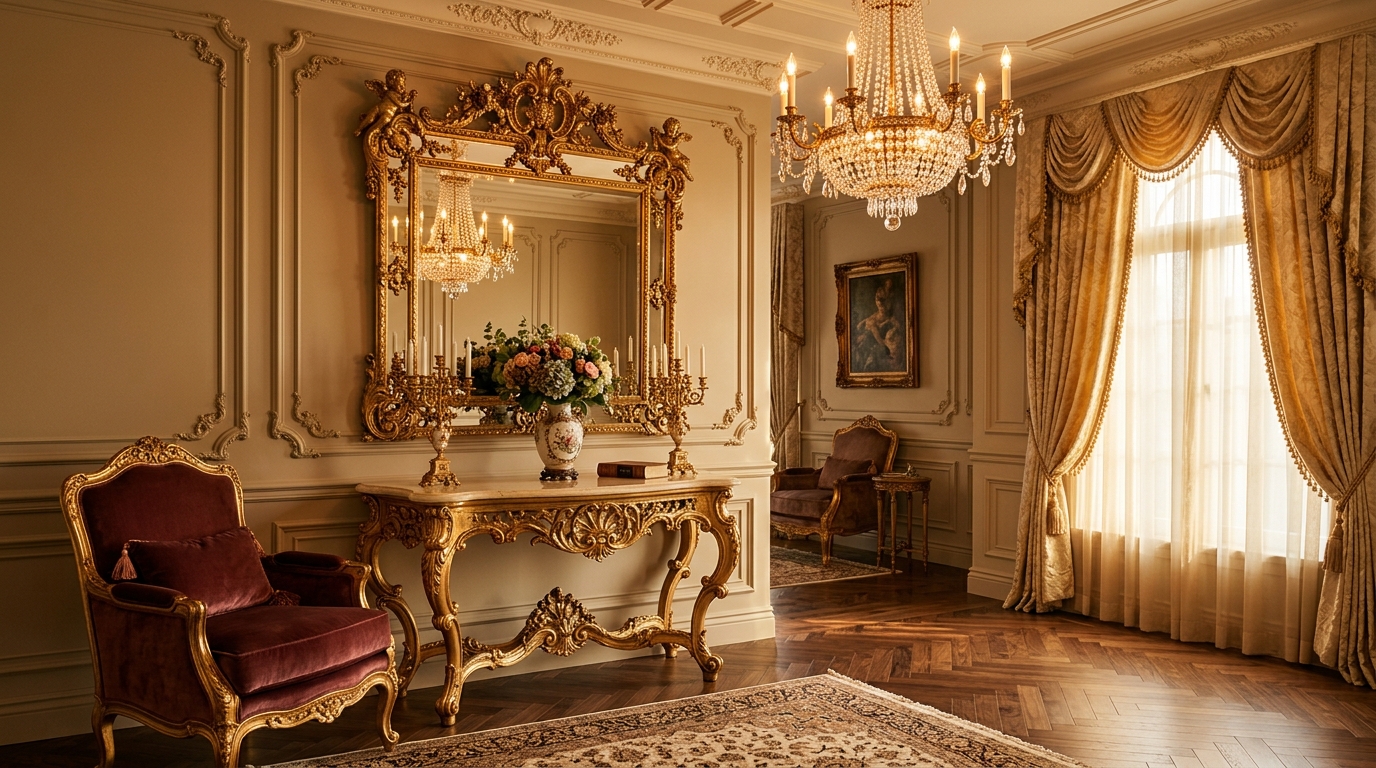
From SoHo lofts to Sunset Boulevard estates, America’s top designers are proving that 17th-century grandeur has never felt more modern.
The Baroque Revival: Why Now?
In 2026, luxury interior design trends USA are taking an unexpected turn—backward. While minimalism dominated the 2020s, today’s most coveted spaces are embracing maximalism with historical precision. Baroque furniture, with its gilded carvings, dramatic silhouettes, and unapologetic opulence, is staging a triumphant return in America’s most design-forward cities.
But this isn’t your grandmother’s Baroque. Interior designers in NYC, LA, and Miami aren’t recreating Versailles. They’re deploying Baroque pieces as strategic disruptors within contemporary architecture—creating tension, dialogue, and undeniable visual authority.
New York City: Baroque as Architectural Contrast
In Manhattan’s glass-and-steel towers, luxury interiors NYC have found their counterpoint in carved walnut and gold leaf.
“Baroque furniture in a white-box minimalist loft is like dropping a chandelier into a swimming pool,” says Elena Voss, whose recent Chelsea penthouse project features a single, monumental Baroque cabinet against raw concrete walls. “The contrast isn’t chaotic—it’s clarifying. The piece becomes the room’s emotional anchor.”
Voss sources many of her statement pieces from Casa Padrino, a European luxury furniture house specializing in authentic Baroque reproductions crafted by traditional artisans. “Their pieces carry the weight of history without feeling like museum artifacts,” she notes. “The proportions work in contemporary volumes.”
The NYC approach is surgical: one Baroque console in an entry hall, a pair of carved armchairs flanking a modern fireplace, a gilded mirror reflecting Central Park views. The city’s designers treat Baroque not as a style to inhabit, but as an accent to deploy—luxury with intellectual rigor.
Los Angeles: Baroque Meets California Casual
If New York uses Baroque for contrast, Los Angeles dissolves the boundary entirely.
“LA doesn’t do stark,” explains Marcus Chen, who recently completed a Bel Air estate where a 12-foot Baroque dining table sits beneath a retractable glass roof. “We soften Baroque with natural light, indoor gardens, and textiles that feel lived-in.”
Luxury interior design trends USA on the West Coast favor what Chen calls “weathered grandeur”—Baroque silhouettes in sun-bleached finishes, gilding toned down to matte bronze, upholstery in sand-colored linens rather than crimson velvets. The result feels less like a palace and more like a sophisticated ruin reclaimed by the Pacific breeze.
Chen’s secret weapon? Scale. LA’s sprawling footprints allow Baroque furniture to breathe. A carved canopy bed that would overwhelm a Park Avenue bedroom becomes proportionate in a Malibu primary suite with 20-foot ceilings and ocean sightlines.
Miami: Baroque Goes Tropical
Nowhere is the Baroque revival more exuberant than in Miami, where baroque furniture Miami has become synonymous with the city’s signature aesthetic: unapologetic, saturated, and globally fluent.
“Miami doesn’t whisper,” laughs Sofia Reyes, whose Design District showroom moves more Baroque inventory than any other style. “Our clients want the drama. The carving. The gold. But they want it under palm fronds and neon.”
Reyes’s recent South Beach project pairs crimson Baroque settees with terrazzo floors and Art Deco lighting—a collision of European history and Miami’s own architectural heritage. The tropical climate demands material innovation; many designers now specify Baroque pieces with marine-grade finishes and outdoor-rated gilding for poolside loggias and rooftop terraces.
The Miami formula is fearless layering: Baroque furniture alongside contemporary art, Cuban tile, and Brazilian modernism. It’s luxury without hierarchy, where a 17th-century-inspired commode and a KAWS sculpture share equal billing.
The Common Thread: Authenticity Over Imitation
Across all three cities, designers emphasize one non-negotiable: quality of craftsmanship.
“The market is flooded with cheap Baroque knockoffs that look like they belong in a theme restaurant,” warns Voss. “True Baroque furniture, whether antique or masterfully reproduced, has a physical presence. The carving has depth. The gilding has warmth. You feel it before you see it.”
This is why established sources like Casa Padrino have become essential to American designers. Their workshop in Europe maintains the hand-carving traditions that define genuine Baroque furniture, while offering customization for contemporary spatial needs—slightly reduced depths for urban apartments, reinforced frames for commercial projects, finishes tailored to coastal or desert climates.
2026 and Beyond: Baroque as Investment
As luxury interior design trends USA continue evolving, Baroque furniture is increasingly viewed not merely as décor, but as collectible asset. Unlike trend-driven contemporary pieces, well-crafted Baroque reproductions and antiques appreciate over time. Designers report clients requesting provenance documentation and artisan certificates with the same diligence they apply to blue-chip art.
“The Baroque revival isn’t nostalgia,” Chen reflects. “It’s a correction. After years of disposable design, people want permanence. They want furniture that will outlast them, that carries narrative weight. Baroque delivers that inherently.”
The Takeaway
Whether deployed as a single statement in a SoHo loft, softened under California sun, or amplified in tropical Miami splendor, Baroque furniture in 2026 is proving that historical grandeur and contemporary living aren’t opposing forces—they’re conversation partners. The designers mastering this dialogue aren’t looking backward. They’re using history to design forward.
Ready to explore authentic Baroque craftsmanship for your next project? Discover curated collections at Casa Padrino.